
During the 50th anniversary of the Organisation of African Unity in May 2013, African leaders adopted the 50th Anniversary Solemn Declaration and committed to developing a continental agenda for the following 50 years. This process produced Agenda 2063, which the African Union adopted in January 2015 as a long-term framework for Africa’s inclusive and sustainable transformation.
Agenda 2063 now operates alongside thousands of national development plans, sector strategies, statutes, regulations and regional frameworks across the African Union’s 55 member states. Although governments and multilateral institutions publish extensive policy material, finding authoritative African policy documents remains a significant challenge for legal scholars, trade analysts, development economists, researchers and investors.
Secondary sources can provide valuable context, but they may omit important details or misinterpret administrative intent. A news article may summarise a proposed tax directive, a consultancy report may interpret an infrastructure roadmap, and an academic paper may analyse energy reforms. When research requires reliable evidence of what a government or regional institution has officially adopted, researchers must consult the original document.
This article explains where to find African policy documents, how to determine whether a document is authoritative and current, and how databases such as Policy Vault can support more efficient research.
Why Primary Sources Matter in African Policy Research
Policy research usually connects several layers of evidence. A policy announcement can show that a government has introduced an initiative. A news report can provide context. An academic study can examine its implications. But the underlying policy document establishes what the institution actually published or adopted.
That distinction is important when research crosses national borders. A researcher comparing agricultural policies across Nigeria, Kenya, Rwanda, and Ghana, for example, cannot assume that documents with similar titles have the same legal or administrative status. Reliable policy research requires more than finding a document with a relevant title. Researchers must identify the issuing institution, confirm the document’s legal or administrative status, check for amendments and determine whether it remains current.
This process becomes more difficult when research spans several African jurisdictions with different publication systems, administrative terminology and levels of digital access. Policy Vault resolves these disconnects and structural challenges by aggregating primary legal documents, official gazette notices, regulatory frameworks, and sectoral strategies from across the African continent into a centralised policy database.
Where to Find African Policy Documents?
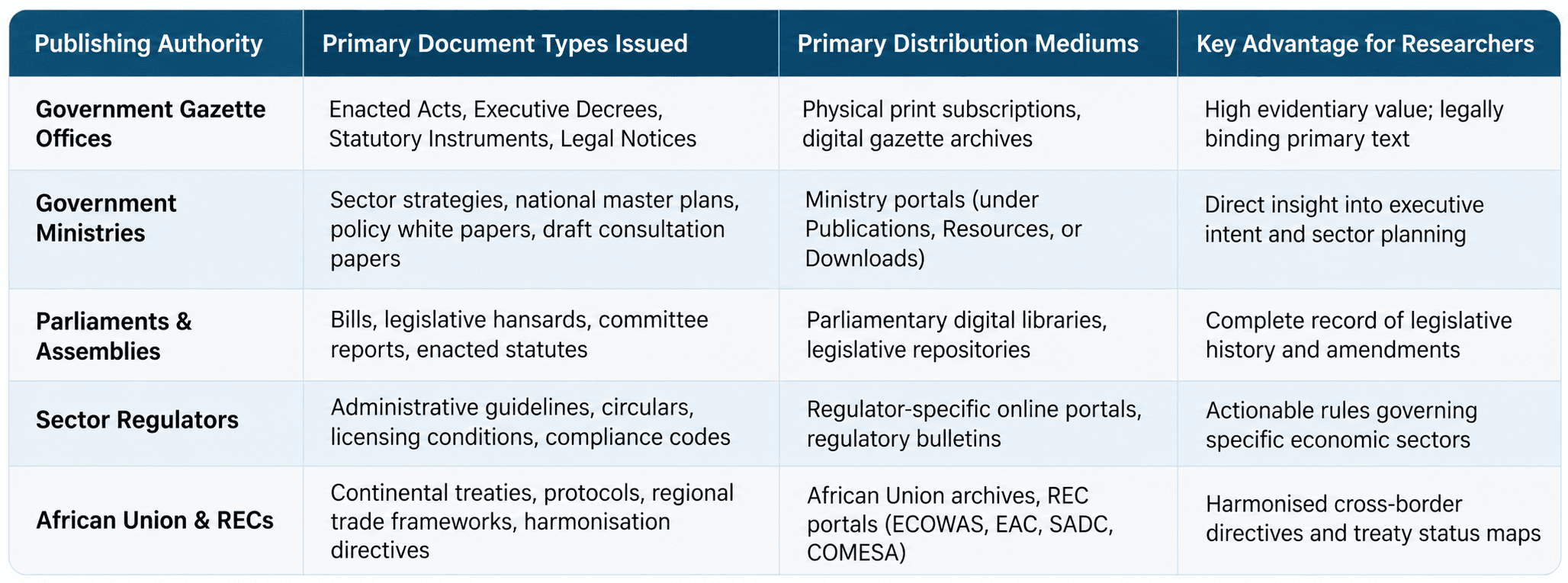
You can find African policy documents through government ministries, official gazettes, parliaments, regulators and other public institutions. At the continental level, the African Union provides dedicated collections for policy documents, treaties, decisions, declarations and other official materials.
For country-level research, however, researchers will generally need to go beyond continental sources and identify the relevant national institution.
Researchers can search individual government portals directly or use an aggregated policy database such as Policy Vault to identify relevant documents before tracing them to their issuing institutions.
Government gazettes and ministry websites
Official gazettes and government ministries serve as the primary legal and administrative channels for publishing public policy across African jurisdictions.
Official gazettes commonly publish legislation, regulations, statutory instruments, executive notices and other legally significant government materials. Depending on the jurisdiction, gazette publication may be required before certain instruments take effect. An official gazette is a government journal or official newspaper of record that publishes public notices, laws, appointments, and state announcements. It is the legally recognised channel for promulgating laws and executive instruments. Examples include South Africa’s Government Gazette (available through the Government Printing Works and commercial legal platforms), Mauritania’s newly launched digital Official Gazette portal (covering texts since 1959), and similar gazette systems across the continent.
Ministry and Agency Websites
Ministry and agency websites often host sector-specific policies, strategies, white/green papers, and implementation plans. Ghana’s Ministry of Health publishes its Medium-Term Development Plans, quality strategies, and sector policies directly on its site. Botswana’s government site, similarly, lists budget speeches, policy summaries, and agency reports with the year and issuing ministry.
Gazettes and ministry pages are primary sources; they should be your first stop when you need the authoritative text of a policy or regulation. However, navigation and search functionality differ widely, and older documents may only exist in PDF archives or physical collections.
African Union
At the continental level, the African Union (AU) maintains several official knowledge platforms that host policy frameworks, implementation plans, and organ documents. AU has a consolidated Knowledge Platform, which is the official research, policy, data, and decision archive of the AU, connecting the 55 member states and Regional Economic Communities under Agenda 2063. The repositories are useful for pan-African frameworks, cross-country commitments, and high-level strategies that national policies often reference or operationalise.
Other Continental Repositories: Continental protocols, treaties, and harmonised trade directives are maintained by the regional economic communities (RECs) such as the Economic Community of West African States (ECOWAS), the East African Community (EAC), Southern African Development Community (SADC), and the Common Market for Eastern and Southern Africa (COMESA).
Parliaments and Legislative Bodies: National assemblies archive legislative bills, committee reports, parliamentary Hansards, and enacted statutes, offering insight into legislative history and statutory intent.
Sectoral Regulators: Independent regulators, including central banks, communications authorities, energy regulatory boards, and competition commissions, issue administrative circulars, licensing frameworks, operational directives, and compliance codes that are published directly on agency platforms.
Research Institutions and Academic Repositories: University policy centers, specialised legal research organisations, and independent research institutions maintain specialised archives that catalogue historical legislation, policy briefs, and comparative regulatory data.
Are All African Government Policies Available Online?
The availability of Policies online varies by country, administrative branch, and sector. However, central banks, tax authorities, and energy regulators across many African states maintain updated digital portals with downloadable PDF directives; official gazettes in several jurisdictions remain physical print documents archived at national libraries or government printing presses.
How to Verify That a Policy Document is Current
Conducting rigorous policy research requires confirming that a retrieved document represents active, binding law or strategy. Utilising obsolete, unratified, or superseded documents can lead to erroneous analytical conclusions, regulatory non-compliance, or flawed market entry strategies.
A policy document's authority depends directly on its position in the administrative hierarchy. Administrative circulars cannot override statutory acts, and draft consultation papers do not carry the force of enacted policy.
How to Approach Checking Dates, Amendments, and Superseded Policies?
Establishing document verification involves evaluating five structural checkpoints:
- Verify Passage vs. Commencement Dates: A statute or executive policy may list an official passage date but feature a deferred commencement clause requiring an executive notification in the official gazette to bring it into force.
- Trace Amendment Histories: Legal and regulatory frameworks undergo continuous modification. Amendments are frequently published as standalone statutory instruments or gazette notices rather than integrated directly into the principal text.
- Establish Administrative Hierarchy: Determine where the document sits within the national legal structure. Administrative guidelines issued by a department minister cannot supersede statutory acts passed by Parliament.
- Distinguish Consultation Drafts from Enacted Policies: Exposure drafts, green papers, and consultation frameworks reflect proposed policy directions, not final binding law.
- Confirm Judicial and Regulatory Status: High Court or Supreme Court rulings can strike down ministerial circulars or statutory provisions on constitutional grounds. Confirming judicial status ensures the policy remains legally enforceable.
What Checklist Should Researchers Use for Verification?
Before citing a policy text as current law or policy, follow this process:
- Official Citation: Does the text contain a formal gazette number, act number, or ministerial reference code?
- Enactment & Commencement: Are both the adoption date and the official commencement date explicitly stated?
- Consolidation Status: Is the text a standalone principal document, or does it incorporate subsequent amendments?
- Issuing Authority: Was the document published directly by the designated statutory authority?
- Superseding Instruments: Has a newer policy, act, or strategy explicitly repealed or replaced this document?
- Judicial Status: Has any provision of the document been struck down by a High Court or Supreme Court ruling?
- Draft vs. Final Status: Is the document labelled as an exposure draft, green paper, or final approved policy?
- Operational Guidelines: Have secondary regulations been promulgated to enforce the main policy text?
- Primary Repository Trace: Can the file be traced back to an official government printer or ministry domain?
How to Build a Reliable Policy Research Workflow
Having a structured workflow can make research more efficient and easier to verify; you can follow this structure:
1. Define the research questionStart with the exact policy issue you are looking to investigate, so instead of searching broadly for "Nigeria economic policy", you have to identify whether you need a fiscal policy document, investment regulation, tax legislation, industrial strategy or another specific instrument.
2. Identify the responsible institutionDiscover which ministry, regulator, parliament, government agency or regional institution has responsibility for the issue.
3. Locate the primary sourcePrioritise the official institution that issued or adopted the document. Secondary sources can help identify relevant documents, but the original document should be checked whenever possible.
4. Verify the documentCheck the publication date, status, amendments, replacement documents and, where relevant, entry into force.
5. Record the sourceFor serious policy research, maintain a research record containing the document title, country, institution, date, source and status. This makes it easier to reproduce the research and identify changes later.
6. Cross-check important claimsWhere a policy has significant legal, regulatory or investment implications, compare the policy document with related legislation, regulations, official notices or implementation documents.
Following this approach will prevent treating a secondary description or outdated document as though it were the current primary source.
How to Search Policies by Country and Sector
Searching for "Africa policy documents" as a single category is rarely the most efficient approach. Africa's policy landscape covers 55 AU member states, each with its own national institutions and policy systems, alongside regional economic communities and continental institutions.
A more useful search begins with three elements:
Country + sector + document type.
Construct search queries using a precise three-part formula:
For example, a researcher studying transportation policy could narrow a search to:
- Ghana + Transport + national policy
A researcher examining trade regulation could search by:
- Nigeria + Trade + regulation
Someone researching healthcare could combine:
- Rwanda + healthcare + policy
This structure can also be applied to sectors including energy, mining, agriculture, telecommunications, technology, investment, education, environmental policy, etc.
Following this method reduces the amount of irrelevant material returned by broad searches and makes it easier to identify the institution responsible for the policy.
It is also useful to distinguish between policy, legislation, regulation, strategy, framework and implementation plan; these documents may seem related but are not necessarily interchangeable.
By categorising documents by country, sector, issuing authority, and publication date, Policy Vault enables researchers, legal professionals, and policy analysts to locate authoritative sources quickly and verify their status accurately.
Search African policy documents by country and sector on Policy Vault Africa.